Limericks, Rhymes and translation challenges

John pic 2013

Oral Bible Translation: power in the words.
John E Stark, August 28, 2018

        Many of my work hours are dedicated to helping people understand and do Oral Bible translation. Oral Bible translation focuses on accuracy of concept transmission and naturalness of expression.  All other formats for Bible translation are tied, in varying degrees, to the shape of the source text.  Here is a non-Biblical illustration of the challenges involved when transferring the shape of the text is important.

Most of us are familiar with the form of a limerick.  Here is an example:

There once was an Irish funster
Who considered himself quite a punster
He’d make up a rhyme
Say it three times
And toss it all into a dumpster.

Imagine having to translate that into a different language.  First of all, you ask “Why would you?” and you do have a point, but run with me here.  The first two lines rhyme the final words, lines 3 and 4 rhyme the final words, and then line 5 has to rhyme with lines 1 and 2.  You also know the syllable count is important.  If that is not right, it simply is not a limerick.

Here is another limerick:

The God of heaven is great
His blessing neither early nor late
He spends all his time
With my best on his mind
All I have to do is wait.

Now we have something worth saying in another language.  The content is clear enough, God’s delivery of blessing is always at just the right time. But said that way it just doesn’t have the stick-in-your-head power of the limerick.  As a translator I want both the concept and the helpful delivery form, but I want the LOCAL helpful delivery form.

When things like this come up in Scripture, traditional translation settles for preserving the form, and losing the impact, of the passage.  Oral Bible translation gives us the opportunity to at least try for both correct content and equally powerful delivery of God’s truth.

Right now I am at the start-up stages on three Oral Bible translation projects that are in restricted information areas.   While I can’t tell you where they are, or exactly what is happening, in future updates I hope to give you background and progress reports that will allow you to pray.

The Need to Pray

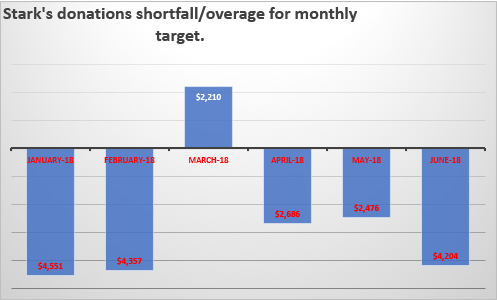
Part of being a missionary is that we are expected to maintain a donor base adequate to cover the cost of our employment at Spoken.  For some time now our gifts have not reached the target amount each month:
2018-08-28 June gift graph

When the numbers are averaged, we were short $2,675.00 per month during the first half of 2018.  Please join us in prayer.  Pray that God will move in surprising and amazing ways to cover the shortfall and provide a stable, adequate monthly donation base.  Pray that I would hear HIS voice as I pursue conversations and share needs.  Mostly pray that this aspect of what we do actually becomes a meaningful ministry into the lives of those I talk to.

John Stark, 14201 County Road 7160, Rolla, MO, 65401

johnstark@spoken.org       cell phone 573-578-8939

On Pundits

Words without Walls
July 3, 2018
John Stark, PhD.

On Pundits


“Silence without sound is like silence with sound, only without sound.”
(J E Stark, May 2018)


You may think the quote above is absolute nonsense.  Perhaps it is.  On the other hand, you may find yourself wondering about things you would have never considered if you had not read the quote.  If so, perhaps there is value in it.  A third option is that you tell yourself, “That sounds deep, but I don’t get it.” If that somehow makes you feel bad, I have done you (and the world) a disservice.

But there is a reason I chose to write this.  In 2018, one of my personal projects is to compare God’s wisdom with the short quotes from people who have been selected by editors and publishers as people who represent the wisdom of mankind.  Even though I wrote the opening quote, I assure you it fits right in with things I am finding in the “wisdom of the world” category.

Here is one from Stephen Hawking:

“The human race is just a chemical scum on a moderate-sized planet, orbiting around a very average star in the outer suburb of one among a hundred billion galaxies.”

Now that’s a quote to brighten anyone’s day, providing reason and purpose to our lives and bringing hope to the hopeless.   Hmm. Do you think?

Let’s try this:

You made my whole being;
you formed me in my mother’s body.
I praise you because you made me
in an amazing and wonderful way.
What you have done is wonderful.
I know this very well.
You saw my bones being formed
as I took shape in my mother’s body.
When I was put together there,
you saw my body as it was formed.
All the days planned for me
were written in your book
before I was one day old.
(Psalm 139:13-16, New Century Version)

Even if we grant equal truth value to the two quotes (which I do not) I would still prefer to read, hear, and embrace the Psalm 139 version of our existence as human beings:  Look at it this way: Would you rather see yourself as blotch of chemical scum smeared over the surface of an unexceptional planet, or would you rather be someone God made in love to be exactly like you are?

As I write this, I wonder what kind of decisions chemical scum gets to make, and I realize I get to make a decision between which of these two “quotes from pundits” will echo in my thoughts the rest of today, and into the next few weeks and years.  The choice seems easy.  I choose to reflect on the Psalm’s explanation of my presence.  Which one will you choose?

Choose wisely,

           John
For your information:

“A pundit is a person who offers to mass media his or her opinion or commentary on a particular subject area (most typically political analysis, the social sciences, technology or sport) on which he or she is knowledgeable (or can at least appear to be knowledgeable), or considered a scholar in said area.”  (Wikipedia, July 2018)